

The Power of Play in Sustainability Learning

Making room for curiosity, connection and better questions.

Photo credit: Nadine Berger
What if learning about embodied carbon began with an invitation to play?
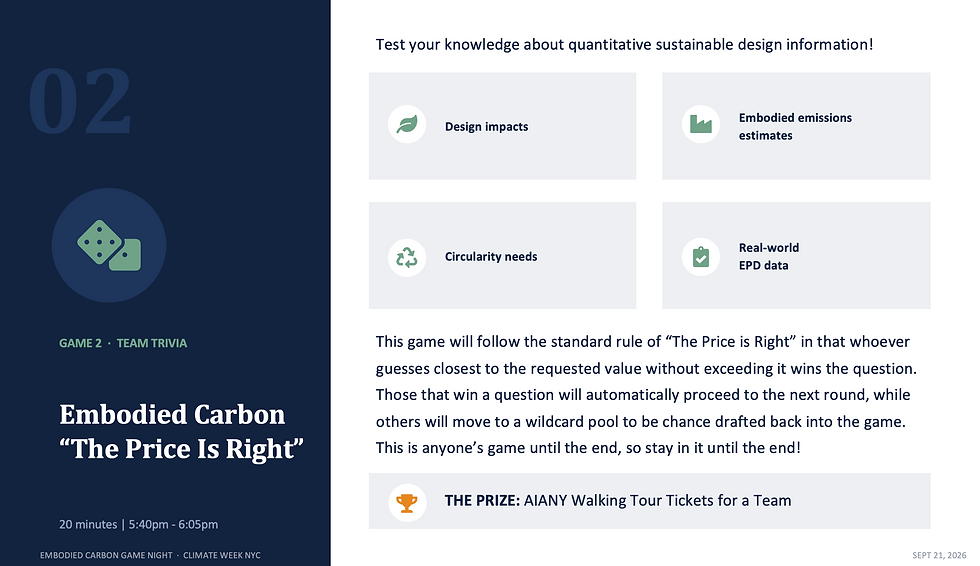
That question helped shape Embodied Carbon Game Night during NYC Climate Week. Our intention was to welcome people with different levels of carbon knowledge, create opportunities to connect and offer an interactive experience in a week filled with presentations.
We wanted people to participate, explore and leave with someone they could reach out to as they continued learning. Above all, we wanted them to bring better questions to their next project.
For me, that is a meaningful goal for sustainability education. We do not all need to be the expert in the room. We do need to recognize where our decisions matter and feel equipped to join the conversation.
An invitation to participate
Sustainability can be an intimidating subject to enter. There are technical terms, assessment tools, rating systems and questions whose answers depend on the project. As someone who works across these topics, I think carefully about how to create an accessible starting point.
Play offers a way to invite people into the work.
A game can ask participants to make a choice, explain their reasoning or consider another person’s perspective. These are useful opportunities to practice the kinds of conversations we want to have on projects.
There is research supporting active participation in learning. Studies in undergraduate science, technology, engineering and mathematics found better examination performance and lower failure rates with active learning than with traditional lecturing. That research examined university courses, rather than professional sustainability game nights, but it provides a useful foundation for considering more participatory approaches to education.
My interest is in how we bring that spirit into applying deeper consideration to architectural practice: making room to test an idea, ask a basic question and work through uncertainty together.

Graphic credit: Madeleine Reid
Practicing the questions we want to ask
About a decade ago, I began to understand the responsibility of being an architect in a deeper way. Decisions that appeared small could carry consequences far beyond the project boundary. Choosing a brick manufacturer, for example, prompted me to think about extraction, labor, transportation and the systems behind a familiar building material. I began asking more questions about what our specifications set in motion.
That perspective informs how I approach sustainability learning today.
For an embodied carbon activity, I would want the discussion to extend beyond identifying a preferred material. What information supports the choice? What assumptions are we making? Could we retain something already in place? Who would we need to involve to explore that possibility?
These questions create a bridge from an educational activity to a real project.
The conversation after the game deserves as much attention as the game itself. What changed someone’s thinking? Where did people disagree? What additional information would help? And what is one question they could bring to their team tomorrow?
Graphic credit: Madeleine Reid
Learning with people we can call later
Connection was another important intention behind our Embodied Carbon Game Night. We wanted people to meet others they could reach out to, so learning could continue beyond the event. Someone might have experience with a tool you are considering, a useful way to explain carbon to a client or a question that helps you see your own project differently.
That is also how I think about sustainability leadership within a firm. A director may guide the work, but I want project teams to feel capable of contributing to it.
Education can help create that shared responsibility when it gives colleagues a role in the conversation. An invitation to compare options or investigate a question provides a concrete place to begin.
Bringing play into practice
In my coaching work with sustainability leaders, we connect firm-wide priorities with decisions on individual projects. Part of that work is considering how colleagues learn, how sustainability advocates engage their teams and how technical knowledge becomes useful in a design conversation.

Graphic credit: Madeleine Reid
Play can be one part of that approach.
A firm might use a short material-comparison activity during a team meeting, invite colleagues to examine a reuse question or discuss a project decision from several perspectives. Each activity needs a clear purpose and time to reflect on what it means for the work ahead.
My ambition for these experiences is straightforward: make sustainability more approachable while giving people something substantive to carry into practice.
As I head to Greenbuild, I am thinking about both what I want to learn and how I can help bring that learning back to the teams I work with.
What question could open a useful conversation? What activity could invite more people to contribute? What would help a colleague feel ready to take the next step?
These are questions I want to keep exploring, together.
At Samskara Studio, I coach sustainability leaders and architecture teams on building sustainability into firm culture and advancing it on individual projects. If you are exploring how to engage your team, let’s connect at Greenbuild or through Samskara Studio.


